Yusai Okuda - Arashiyama Yusai-tei gallery

The Arashiyama Yusai-tei gallery, also known as Somekobo Yume Yusai, is located overlooking the Katsura River in Kyoto. This beautiful structure was built approximately 150 years ago during the Meiji Period; however, its initial purpose was to serve as an inn for the geisha, Japanese female entertainers, and maiko, apprentice geisha. The Katsura River has been a culturally significant part of Kyoto's history since the Heian Period (794-1185). Heian translates to “peace” or “tranquility” in Japanese, and these feelings are directly reflected in how this gallery uses its natural surroundings to evoke tranquility in visitors, offering a unique experience for tourists. This gallery features several scenic spots, each evoking feelings of awe and serenity.
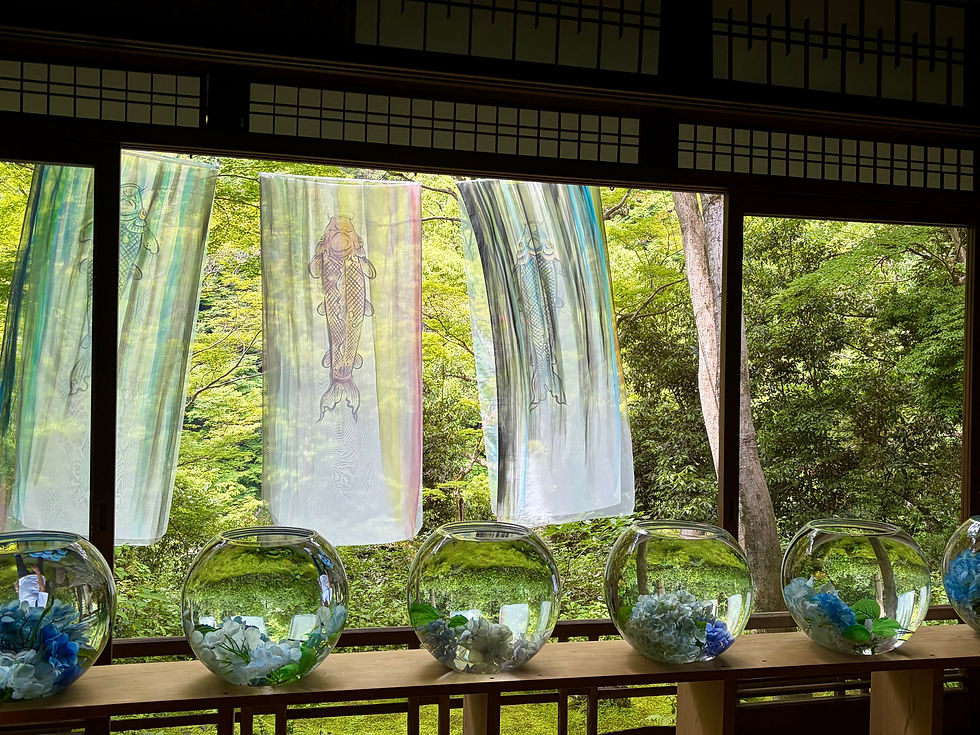
The first room is called Yasunari Kawabata’s Room. Inside the room, a long table extends across the window, holding several spherical glass vases filled with water and hydrangeas. Because of the vase’s shape, when looking through it, everything on the other side of the glass is flipped upside down. Outside the window, three large silk fabrics featuring koi fish are being dyed by artist Yusai Okuda. He was inspired by traditional Japanese dyeing techniques and combined them with his own innovations to create the Yume-Korozome technique, which uses silk and dyes that allow the artwork to change hues under different lighting. Okuda combines his own artistic talent with the conditions that nature provides, such as sunlight and wind, to create these ethereal artworks.
One of the most prominent rooms, the Round Windows Room, features several circular windows that create a lookout into the surrounding forest. As the seasons change and the leaves change colour, the ambiance of the room also changes with it, showing another example of Okuda’s use of his natural surroundings. Inside the room, there are two reflective tables, one for each set of windows. As viewers sit behind the tables, they can see both the windows and their reflections below.

Another captivating space in the gallery moves the visitors outside, where there sits a low , hollow table filled with water dyed black. The water is positioned on the edge of the terrace, in front of the lush greenery and open view of the Arashiyama hillside. As the light breeze shakes each individual leaf of the trees ahead of the table, the same happens in the reflected image in the still water. Visitors are able to interact with this piece through creating ripples in the water, blurring the line between the natural world and the "canvas."

Stepping back into the gallery, visitors can see Yusai's dyeing workshop, where his creative process comes to life. His art serves as a reminder that the nature that surrounds him is a powerful tool that acts as a co-creator of his art, where the sunlight changes the hues of the dyes and silk, the wind creates movement on his "canvas," and the seasonal changes evoke a specific ambience of the experience.
Comments